


It becomes increasingly simpler to create custom little apps with tools like Claude, Gemine and co. While it’s fun for private use, in an enterprise environment, it might cause a lot of issues. From the risk of exposing confidential data, to truly helpful tools that only you have access to. Wouldn’t it be great to place those artifacts in a safe spot and professionalize their use if needed?
Today, most users wouldn’t be able to copy files around, write a Dockerfile, set up a CI pipeline, configure Kubernetes manifests, or simply give up and share a screenshot. For non-technical employees who just vibe-coded something useful, that wall ends the journey before it begins.
That’s exactly the problem vibeD is built to solve.
What is vibeD?
vibeD bridges the gap between AI code generation and production deployment. It exposes an MCP (Model Context Protocol) server that AI agents can call directly, handling the entire lifecycle from source files to a running, publicly accessible service.
The flow is intentionally simple: an AI agent calls deploy_artifact with the source files it just generated and vibeD takes care of the rest. The user gets back a URL. Done. No deployment expertise required.
Leave me a ⭐️ on the project if you like it and support my work.
How it works: Two lanes, one API
The current release rethinks the deploy path from the ground up, replacing the old build-and-deploy model with something fundamentally faster and more isolated.
You never pick a runtime. A deterministic classifier reads the source, file names, package.json keys and routes each app to one of two lanes:
Fast lane: V8 isolates (workerd) and static sites. Sub-second deploys.
General lane: Kata + Firecracker microVMs for arbitrary code (Node, Python, Go), with hardware-grade isolation.
The HTTP API is uniform across both. The routing is automatic; picking a lane is the exception, not the workflow.
Warm pools, not builds
The key architectural insight in vibeD is warm pools. vibeD keeps pre-booted sandboxes ready for every runtime template. A deploy claims one and injects your source tarball into it. There’s no docker build, no image push, nothing between POST /v1/deploy and your URL sitting ready:
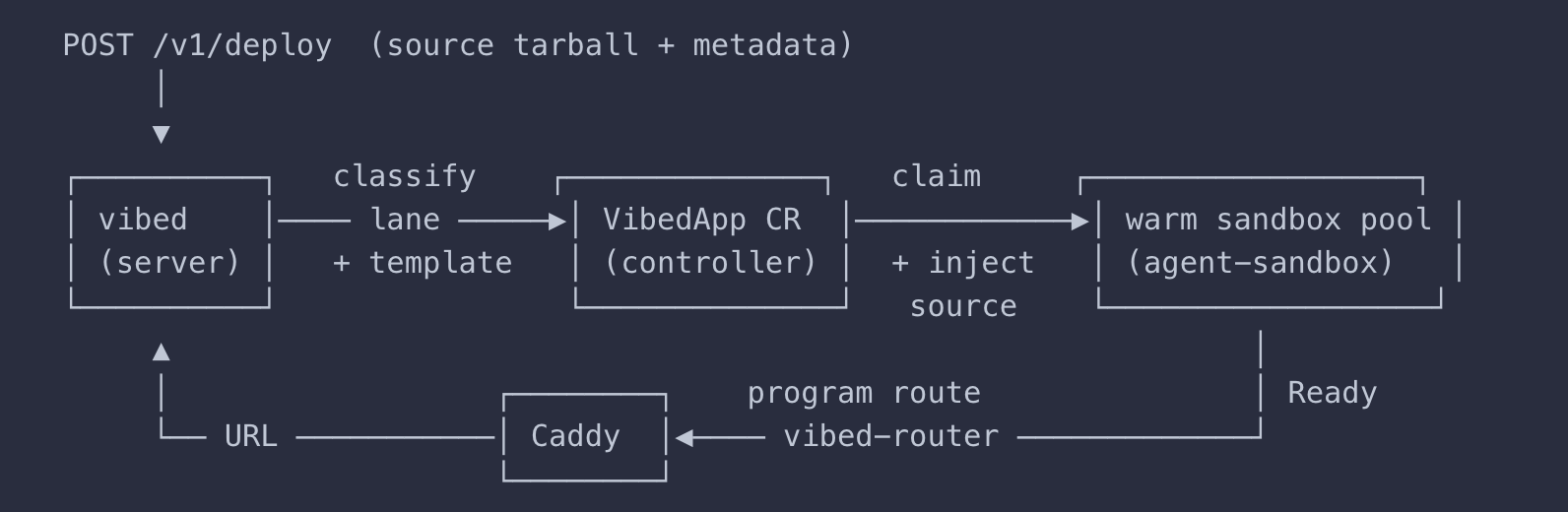
New dependency combinations are handled by an async template builder that refreshes the pool out of band. It never blocks a user-visible deploy. The result: getting an AI-generated app to a live URL happens in seconds, not minutes.
The MCP integration
What makes vibeD fundamentally different from yet another deployment tool is the Model Context Protocol. MCP is an open standard that lets AI models interact with external tools in a structured way. The AI discovers available tools, understands their schemas, and calls them autonomously.
vibeD exposes MCP tools that cover the full artifact lifecycle: deploy, update, list, inspect, rollback, share, and delete. An AI agent doesn’t need to know about containers, Kubernetes or networking. It just calls deploy_artifact with the files it generated.
This means any MCP-compatible AI tool can deploy to your infrastructure: Claude, VS Code with Copilot, custom agents, or tools that don’t exist yet. vibeD is the bridge between “AI generated code” and “running application” and MCP is what makes it universally accessible.
Architecture
The control plane is split into four stateless pieces:
vibed: the API server, dashboard, and MCP server
vibed-controller: reconciles each
VibedAppto Readyvibed-router: programs Caddy routes (wildcard DNS-01 TLS in production)
Caddy: the reverse proxy that fronts every app
vibeD owns exactly one CRD, VibedApp, and reuses kubernetes-sigs/agent-sandbox for the rest. Each app gets its own Service, so Caddy proxies correctly across pod restarts and when a pod is recreated, the controller re-injects source automatically. Apps self-heal.
Five runtime templates are available today: node-24, python-313, go-123, base-al2023 and static-nginx.
What’s ahead
vibeD is at the beginning of its journey. The vision goes further than the current release:
OAuth / OIDC authentication: integrate with corporate identity providers so every employee gets their own deployment space
Multi-tenant isolation: namespace-per-user or namespace-per-team, with resource quotas and network policies
GitOps integration: store artifact definitions in Git and reconcile with Flux or Argo CD
Cost visibility: show teams what their artifacts cost, and auto-cleanup idle deployments
Template marketplace: pre-built starting points for common artifact types
The broader bet is this: as AI tools become the primary way non-technical people create software, the deployment layer needs to become invisible. vibeD is that invisible layer, a platform that AI agents talk to natively, so humans never have to think about it.
Test it yourself
Try out vibeD, and see how it is going for you. As it is in a pretty early stage, I’m looking forward to getting feedback on helpful features, experience, and issues.
Leave me a ⭐️ on the project if you like it and support my work.